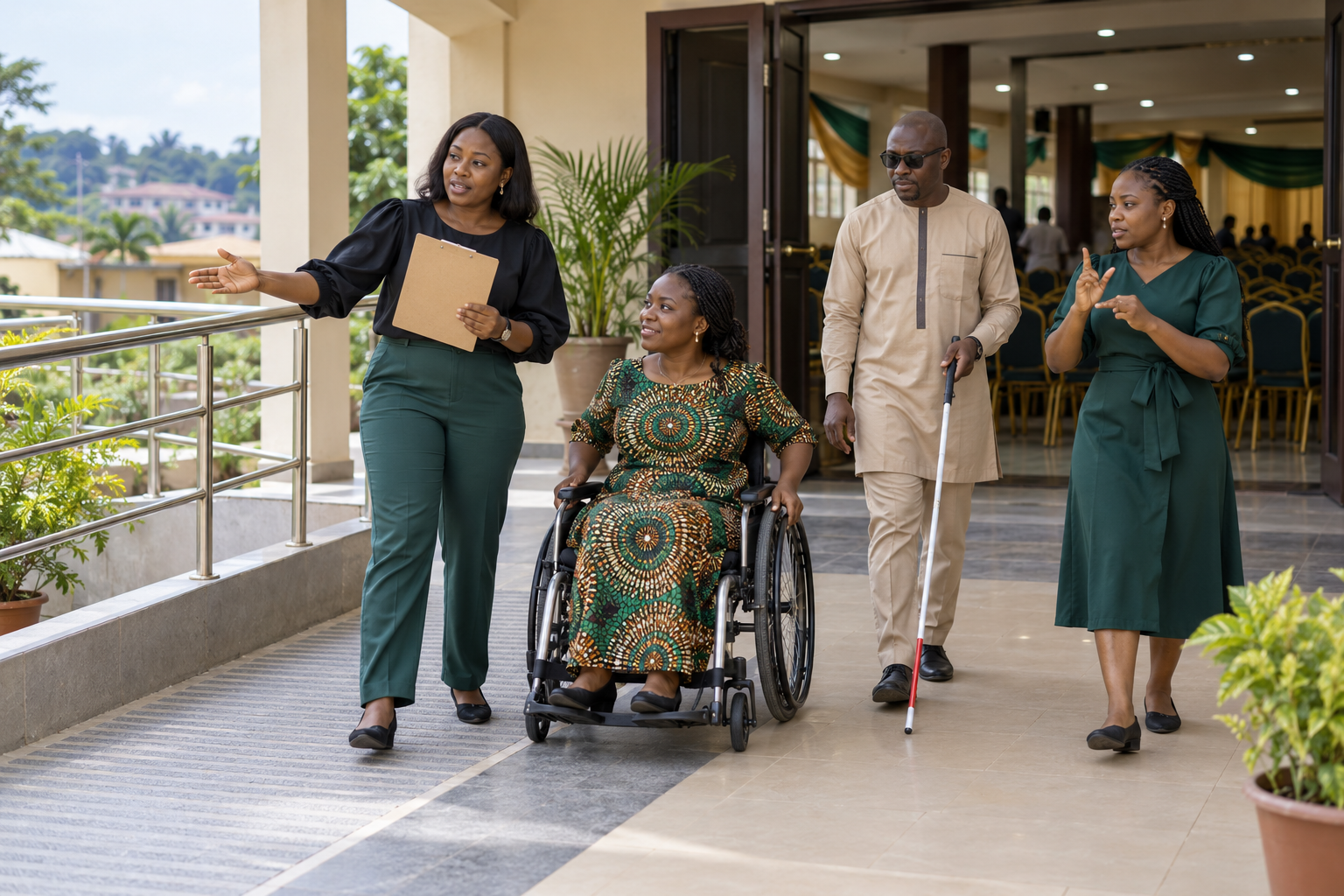
An event can be open to the public and still exclude people. A staircase at the only entrance, information available in one format, poor lighting, an unsafe meeting time, or no opportunity to request support can prevent citizens from participating. Accessible democracy begins when organisers treat inclusion as part of programme design—not as a favour offered after plans are complete.
Women and persons with disabilities are not single, uniform groups. Their circumstances differ by age, location, income, language, caregiving responsibility, type of disability, and access to transport or technology. Good voter education therefore starts by asking participants what barriers they face and involving them in practical decisions.
Check the whole journey
Venue access is more than a ramp. Organisers should consider the route from the street or transport drop-off, entrances, door width, floor surfaces, seating space, toilets, lighting, ventilation, and emergency exits. A ramp that is too steep or blocked by furniture is not meaningful access. Clear directions and a contact person can help participants ask questions before travelling.
Safety and timing also matter. A session scheduled very late may be difficult for people who depend on public transport or carry caregiving responsibilities. Where possible, publish the start and finish times, avoid unnecessary delays, and explain any security or entry procedure in advance.
Offer information in usable formats
Voter education should use plain language and explain technical terms. Important points can be provided in more than one format: clear spoken explanation, readable print, accessible digital files, captioned video, or sign-language interpretation where arrangements allow. Good contrast, legible type, logical headings, and descriptions of meaningful images make digital and printed information easier to use.
Facilitators should face participants when speaking, use a microphone when required, and repeat audience questions before answering. They should avoid speaking about a participant as though that person is absent. An assistant, interpreter, or support person should not replace the participant’s own voice.
Language inclusion matters as well. Organisers may need to identify the languages commonly used in a community and plan translation or interpretation responsibly. It is better to communicate a smaller amount of accurate information clearly than to overwhelm people with unfamiliar terminology.
Design for participation, not attendance alone
Inclusion is not achieved simply because diverse people appear in a photograph. Participants should have a fair opportunity to ask questions, contribute examples, and challenge assumptions without ridicule. Small-group activities, multiple ways to submit questions, and sufficient pauses can help people who need more processing time or who are uncomfortable speaking to a large room.
Respect privacy when support is requested. Ask what assistance would be useful instead of making assumptions based on appearance. Do not require a person to disclose unnecessary medical details. Collect only the information needed to arrange participation, restrict access to it, and explain how it will be handled.
Learn and improve
No organiser will anticipate every barrier. Provide a simple way for participants to report an access problem before, during, and after a programme. Review the feedback and record what should change next time. Where resources are limited, be honest about what can and cannot be provided, and seek practical alternatives with the affected participant.
CLAI’s civic learning work is guided by a basic principle: every eligible citizen should be able to find understandable information and participate with dignity. Accessible voter education strengthens the whole electorate because it replaces assumptions with listening and turns a general invitation into a real opportunity to take part.